

Quick answer
The whale watching Maui season runs from mid-December through late April, with humpback whales migrating 3,000 miles from Alaska to breed and calve in Hawaiian waters. Peak viewing occurs in February and March when whale populations reach their highest concentration and mothers with newborn calves become visible near shore. Early-season sightings feature courtship behavior and competitive pods, while late-season departures in April show mothers preparing calves for the return journey north.
More than 10,000 North Pacific humpback whales pass through the Hawaiian Islands Humpback Whale National Marine Sanctuary each winter, with Maui's sheltered channels hosting the densest aggregations in the archipelago. The migration begins in late November when pregnant females and mature males depart Alaskan feeding grounds, traveling roughly 40 miles per day to reach Hawaiian waters by mid-December. Calves born in January and February remain in shallow bays for eight to twelve weeks, nursing and building blubber reserves before attempting the northward crossing. Whale watching Maui season follows a predictable arc shaped by reproductive cycles and ocean temperature. December and early January bring the vanguard—competitive male groups engaging in surface-active behavior as they establish dominance hierarchies. February marks the population peak when 60 to 70 percent of the migratory population occupies Maui's waters simultaneously, creating near-guaranteed sightings on morning departures. March sustains high whale density but shifts toward maternal pairs, with calves practicing breach sequences and pectoral slaps under close supervision. April initiates the exodus as whales begin their return migration, though stragglers and late-born calves extend sightings into early May. Ocean conditions vary across the season in ways that directly affect tour quality. Winter swells generated by North Pacific storm systems peak in January and February, occasionally forcing cancellations on the island's northwest coast but leaving the south and west shores accessible. Trade winds calm between December and March, producing the glassy morning surfaces that allow underwater visibility and distant spotting of blows. Water temperature holds steady near 75°F throughout the season, warm enough to sustain newborn calves but cold enough to trigger the whales' eventual departure as Alaska's krill blooms begin in spring. Maui's western coastline from Lahaina to Maalaea offers the most consistent access, with shallow channels between Maui, Lanai, and Molokai funneling whale traffic into predictable corridors. Morning departures between 7:00 and 10:00 capitalize on calm seas and the whales' increased surface activity after overnight rest periods. Tour operators run daily during the season, with availability tightest in February when advance booking becomes necessary. The humpback whale season in Maui operates on a timeline set by biology rather than tourism, making February and March the empirically optimal window for combining sighting probability with favorable sea state.
“More than 10,000 North Pacific humpback whales pass through the Hawaiian Islands Humpback Whale National Marine Sanctuary each winter, with Maui's sheltered channels hosting the densest aggregations in the archipelago.”
Whale Watching Maui Season Costs and Fees
Accessing the ocean in Maui is free of charge. The costs associated with whale watching are determined by independent boat tour operators based on the vessel, duration, and amenities provided.
Adults typically pay variable rates per tour, with final pricing dependent on the chosen operator and vessel type.
Preparing for Your Whale Watching Maui Season Trip
A few practical steps will help you make the most of your ocean excursion.
-
Book your tour in advance — Peak season tours fill quickly, especially morning departures.
-
Check weather and sea conditions — Ocean swells can affect comfort and visibility during your trip.
-
Bring reef-safe sunscreen — Hawaii law prohibits sunscreens that harm coral ecosystems.
-
Pack motion sickness medication — Even calm mornings can produce swells that affect sensitive passengers.
-
Wear layers and a windbreaker — Temperatures drop on the water, and spray from the boat adds wind chill.
-
Bring binoculars and a camera — Whales surface unpredictably, and magnification helps you track distant activity.
-
Arrive 15–30 minutes early — Boats depart on time, and you'll need to check in and board.
Facts About the Whale Watching Maui Season
Humpback whales, or koholā, migrate thousands of miles to Hawaii to breed, calve, and nurse their young. Observing their distinct social and physical behaviors provides insight into these protected marine mammals.
40 to 50 feet in length
Adult humpback whales typically reach lengths of 40 to 50 feet and can weigh up to 40 tons. Females are generally larger than males of the same age.
Breaching as a form of communication
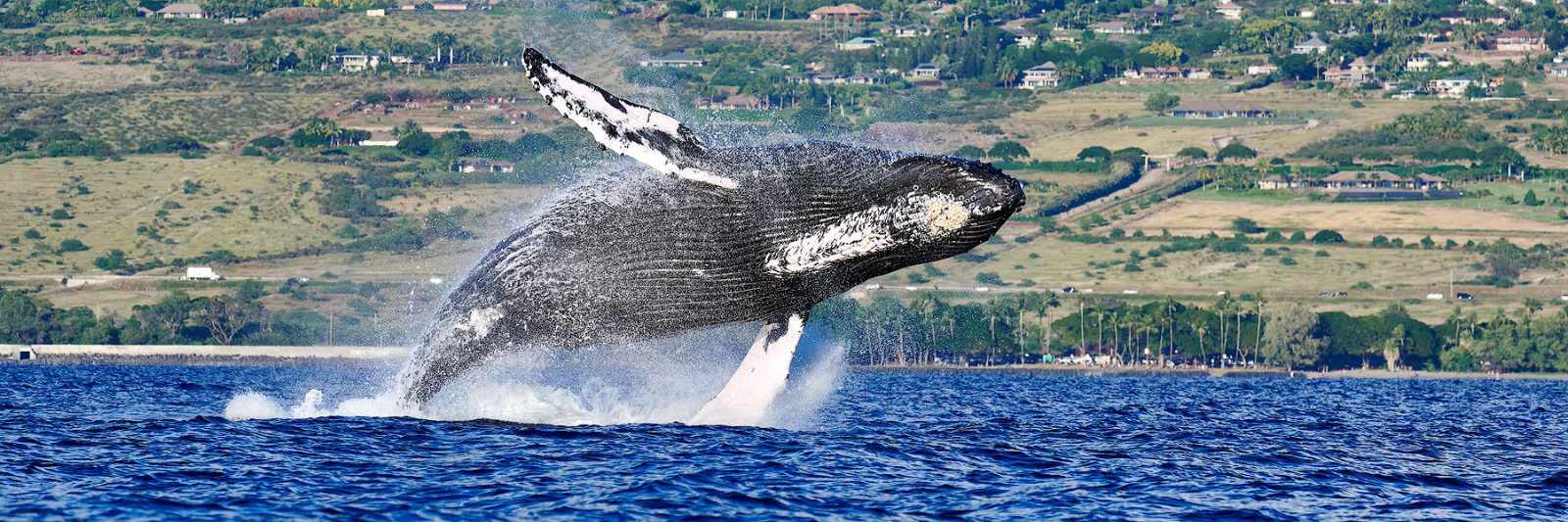
Whales frequently propel their bodies out of the water in a behavior known as breaching. Scientists hypothesize this may serve to remove parasites, communicate with other whales, or signal aggression.
Males sing complex underwater songs
Only male humpback whales sing, producing long, complex sequences of moans, cries, and chirps. These songs can last for up to 20 minutes and are repeated for hours at a time.
Pectoral fins reach 15 feet
A humpback whale has two large pectoral fins that can grow to approximately one-third of its total body length. These fins are used for steering and social interaction.
Calves consume 100 gallons of milk daily
Humpback whale calves are born at approximately 10 to 15 feet long and grow rapidly by consuming high-fat milk from their mothers. They stay with their mothers for about one year before weaning.
Tail flukes serve as identification
Each whale possesses a unique pattern of markings and serrations on the underside of its tail flukes. Researchers use these patterns to identify and track individual whales over multiple seasons.
Check availability
Frequently asked questions about whale watching maui season
Everything you need to know about whale watching maui season